If you’ve recently broken your elbow, chances are you have a lot of questions swirling around. What does treatment look like? When can you get back to normal? Elbow fracture recovery isn’t always a quick or simple process, and I want to be upfront with you about that from the start. But here’s the good news: many patients do recover well, and understanding what lies ahead can make the whole journey a lot less stressful.
The elbow is one of the more intricate joints in the body. It connects three bones (the humerus (upper arm), the radius, and the ulna) and it allows your arm to bend, straighten, and rotate. When any part of that system breaks, the whole joint can be affected. Recovery takes a carefully staged approach that balances protecting the fracture while keeping the joint mobile enough to prevent stiffness.
Key Takeaways
- Elbow fractures vary widely in severity, and treatment, whether surgical or non-surgical, depends on the specific fracture type and how much the bone fragments have shifted.
- Stiffness is one of the most common challenges during recovery, which is why early, controlled movement is often built into the treatment plan from the beginning.
- Many patients may see meaningful progress within three to six months, though maximal recovery may take longer depending on the complexity of the injury.
Understanding the Different Types of Elbow Fractures
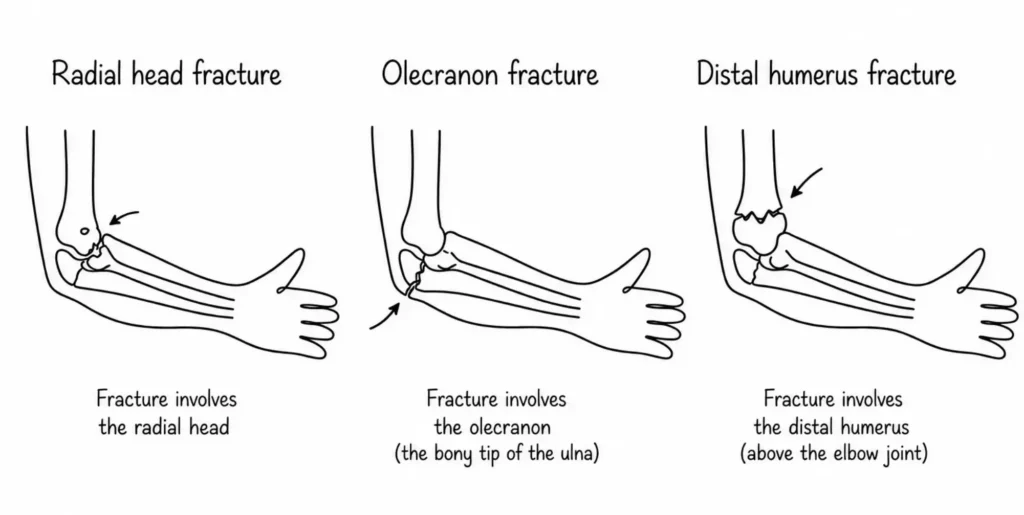
Not all elbow fractures are the same. The specific bone that breaks, and how it breaks, plays a significant role in how recovery unfolds. The three most common types I see are radial head fractures, olecranon fractures, and distal humerus fractures.
Radial head fractures are probably the most frequent. They typically happen when someone falls on an outstretched hand, and the impact travels up through the forearm and into the elbow. Many radial head fractures are non-displaced, meaning the bone pieces stay in good alignment, and these often heal well with conservative management.
Olecranon fractures involve the bony point at the back of the elbow, the part you can actually feel when you touch the tip of your arm. These tend to be more complex because the triceps muscle attaches directly to the olecranon and can pull the fracture fragments apart. As a result, olecranon fractures more frequently require surgical fixation.
Distal humerus fractures involve the lower portion of the upper arm bone, right where it forms the elbow joint. These can be fairly involved injuries, often requiring surgery to restore the joint surface and stabilize the bone fragments. Recovery from distal humerus fractures also tends to be the most prolonged of the three.
Some patients also present with fractures involving multiple bones or fractures that occurred alongside a dislocation. These combined injuries add another layer of complexity to treatment and recovery, but they’re manageable with the right care.
The Initial Evaluation and Treatment
In the immediate aftermath of an elbow fracture, the goals are straightforward: manage pain, reduce swelling, and figure out exactly what you’re dealing with.
X-rays are the starting point for nearly every elbow fracture. They can usually show which bone is involved, how the fracture looks, and whether any fragments have shifted out of place. In some cases, particularly when the fracture involves the joint surface or when we suspect soft tissue damage, a CT scan may also be ordered to get a more detailed picture.
Your arm will likely be placed in a splint during this early phase. A splint, unlike a cast, allows for some swelling without cutting off circulation. You’ll typically wear it for anywhere from a few days to a couple of weeks depending on your specific injury.
Pain and swelling are completely normal at this stage. Keeping your arm elevated as much as possible and applying ice can help manage both. Over-the-counter anti-inflammatory medications may also be appropriate, though I always recommend checking with your care team before starting anything new.
Non-Surgical Recovery: What the Process Looks Like
Not every elbow fracture requires surgery. Many radial head fractures, for example, may heal well without any operative intervention. When the bone fragments are well-aligned and stable, conservative management is often the right path.
Non-surgical treatment typically involves a period of immobilization, followed by a carefully guided return to movement. Here’s the thing about the elbow, though. It tends to stiffen up very quickly. Letting the elbow sit completely still for too long can create stiffness that becomes its own separate problem to solve.
Once your fracture reaches a point of adequate healing, we’ll usually start introducing gentle range-of-motion exercises. This doesn’t mean lifting weights or pushing through sharp pain. It means working with a physical therapist to begin restoring your mobility in a controlled, progressive way.
Even with conservative care, patience is key. Straightforward elbow fractures can still take six to eight weeks or more for the bone to heal adequately. Regaining full motion and strength often takes longer than that, and that’s okay. The process unfolds in stages, and each stage builds on the last.
Surgical Recovery: When Surgery May Be Needed
Some elbow fractures do require surgery. The main reasons I typically recommend operative treatment include:
- Significantly displaced fractures where the bone fragments have shifted out of alignment and won’t heal properly on their own
- Fractures involving the joint surface that need to be precisely reconstructed
- Injuries where soft tissue damage, like ligament tears, is part of the picture
- Fractures, such as many olecranon injuries, where muscle forces would continue pulling the fragments apart without fixation
The specific surgical approach depends entirely on the fracture pattern. In many cases, we use plates, screws, or pins to hold the fragments in the proper position while the bone heals. In certain radial head fractures that are too severely damaged to repair, replacing the radial head with a prosthesis may be the better option. Distal humerus fractures may require more extensive reconstruction, but the goal is always the same: restore a stable, functional joint. Post-surgical recovery follows a similar staged progression to non-surgical care, with additional specifics around timing.
Physical Therapy: The Heart of Elbow Fracture Recovery
Therapy generally progresses through several distinct phases. In the early phase, the primary focus is on protecting the fracture while managing pain and swelling. Your therapist will guide you through specific exercises designed to encourage movement without putting undue stress on the healing bone.
As healing progresses, the focus shifts toward restoring full motion. The elbow can be particularly stubborn when it comes to regaining that last bit of extension, the final few degrees of straightening. Your therapist may use stretching techniques, progressive splinting, or other tools to work through this. Consistency with therapy is an important part of supporting recovery during this phase.
As healing progresses and motion improves, strengthening exercises are gradually introduced to support recovery. This phase builds the muscle support around the joint and gradually prepares you for a return to your normal activities.
For athletes or those with physically demanding jobs, a sport- or work-specific phase of rehabilitation may also be incorporated. As part of my sports medicine approach, I try to make sure active patients get targeted, purposeful rehab that gets them back to doing what they love.
Warning Signs to Watch For
During your recovery, there are certain symptoms that should prompt you to reach out to your care team sooner rather than later:
- Increasing pain that seems to be worsening rather than gradually improving over time
- New or significant swelling after a period of reduction
- Signs of infection following surgery, such as increasing redness, warmth, drainage, or fever
- Numbness or tingling in the hand or fingers
- A feeling that something has shifted or that the arm is giving way
These symptoms don’t always mean something has gone wrong, but they may warrant an evaluation to make sure everything is on track.
Summary
Elbow fracture recovery requires patience, consistency, and a good working relationship with your care team. The type of fracture you have, whether surgery is needed, and how you engage with rehabilitation all play a meaningful role in how well you do. The most important thing you can do to support your own recovery is to stay engaged with your treatment plan, be honest about how you’re feeling, and take rehabilitation seriously.
Frequently Asked Questions
How long does elbow fracture recovery typically take?
Recovery time can vary quite a bit depending on the fracture type and whether surgery was required. For minor, non-displaced fractures managed without surgery, many patients start to notice improvements within six to eight weeks, though full strength and motion may take three to six months to restore. More complex fractures may take longer. Your surgeon and therapist will provide a more personalized timeline based on your specific injury and how you’re progressing.
Will I regain full range of motion in my elbow after a fracture?
Many patients do recover full or near-full motion, but it isn’t guaranteed for every fracture type. Stiffness is a common challenge following elbow injuries, which is why early and consistent physical therapy matters so much. Staying consistent with your therapy program and following your recovery protocol supports your outcome.
When can I return to sports or physical work after an elbow fracture?
This depends heavily on your specific fracture and what activities you’re hoping to return to. For lighter recreational activities, many patients can gradually resume around three to four months after injury. For athletes in overhead or throwing sports, or for individuals doing heavy physical work, the timeline is typically longer. Return-to-activity recommendations should always be tailored to your specific situation, so this is something to discuss with your surgeon as you move through your recovery.