If you play baseball, tennis, volleyball, or swim competitively, your shoulder carries a significant load with every throw, serve, or stroke. That repetitive stress adds up over time, and without the right habits in place, it can lead to pain, inflammation, or injury that sidelines you for weeks, or longer. Understanding how to prevent shoulder injuries in overhead sports is one of the most valuable things an overhead athlete can do to stay competitive and healthy for the long haul.
In my practice, I work with a lot of overhead athletes, from weekend recreational players to high-level competitors. In this post, I want to walk through the most important strategies for keeping the shoulder healthy through a demanding overhead sport season.
Key Takeaways
- Overhead athletes place exceptional and repetitive demands on the shoulder, particularly the rotator cuff, labrum, and surrounding structures, making proactive prevention strategies essential.
- Rotator cuff strengthening, scapular stability work, smart load management, and proper mechanics each play an important role in reducing shoulder injury risk.
- Pain is a warning sign, not something to push through. Addressing discomfort early may help improve outcomes and potentially shorten recovery time compared to delaying evaluation.
Why Overhead Athletes Face a Higher Risk
The shoulder is the most mobile joint in the human body. That mobility is a tremendous asset for overhead sport performance, but it also means the joint relies heavily on muscles, tendons, and ligaments for stability, rather than bony structure alone.
During throwing or overhead motions, the shoulder moves through a wide arc at high speed and significant force. A baseball pitcher can generate extremely high arm speeds during a single pitch. Swimmers repeat similar motions thousands of times in a single training session. Tennis players load the shoulder repeatedly with each serve and overhead stroke. Over time, this kind of high-volume, high-intensity loading can take a toll, especially when supporting structures are not adequately conditioned.
Common overhead sport injuries include rotator cuff tendinitis and tears, labral damage, shoulder impingement syndrome, and biceps tendon irritation. Many of these develop gradually, building up over weeks or months rather than occurring in one dramatic moment.
Understanding What the Shoulder Is Actually Doing
Before diving into prevention strategies, it helps to have a basic sense of what is happening inside the shoulder during overhead activity.
The rotator cuff, a group of four muscles surrounding the shoulder joint, works constantly during overhead motion to keep the ball of the arm bone centered in the joint socket. These muscles must fire rapidly and in precise coordination. If one becomes weak or fatigued, shoulder mechanics can be affected, which may contribute to altered joint positioning and increased stress on surrounding tissues.
The labrum, a ring of cartilage lining the socket, also absorbs meaningful stress during overhead loading. Repetitive throwing can gradually stress or fray this structure. The shoulder’s ligaments can stretch with repeated use, a phenomenon sometimes referred to as “thrower’s shoulder,” reducing the passive stability the joint normally relies on. Understanding these dynamics is part of why learning how to prevent shoulder injuries in overhead sports requires more than just throwing less. It calls for a well-rounded approach that addresses strength, mechanics, and recovery together.
Building a Strong Foundation: Rotator Cuff and Scapular Strength
Strengthening the rotator cuff is arguably the most important thing an overhead athlete can do to protect the shoulder. These four small but critical muscles provide the dynamic stability the shoulder depends on during high-speed movement.
Many athletes focus primarily on larger, more visible muscles, such as the deltoid, chest, and upper back, while neglecting the rotator cuff entirely. That imbalance can set the stage for injury. A powerful deltoid pushing the arm through motion without an adequately conditioned rotator cuff to stabilize the joint is a recipe for increased wear on the tendons and surrounding structures.
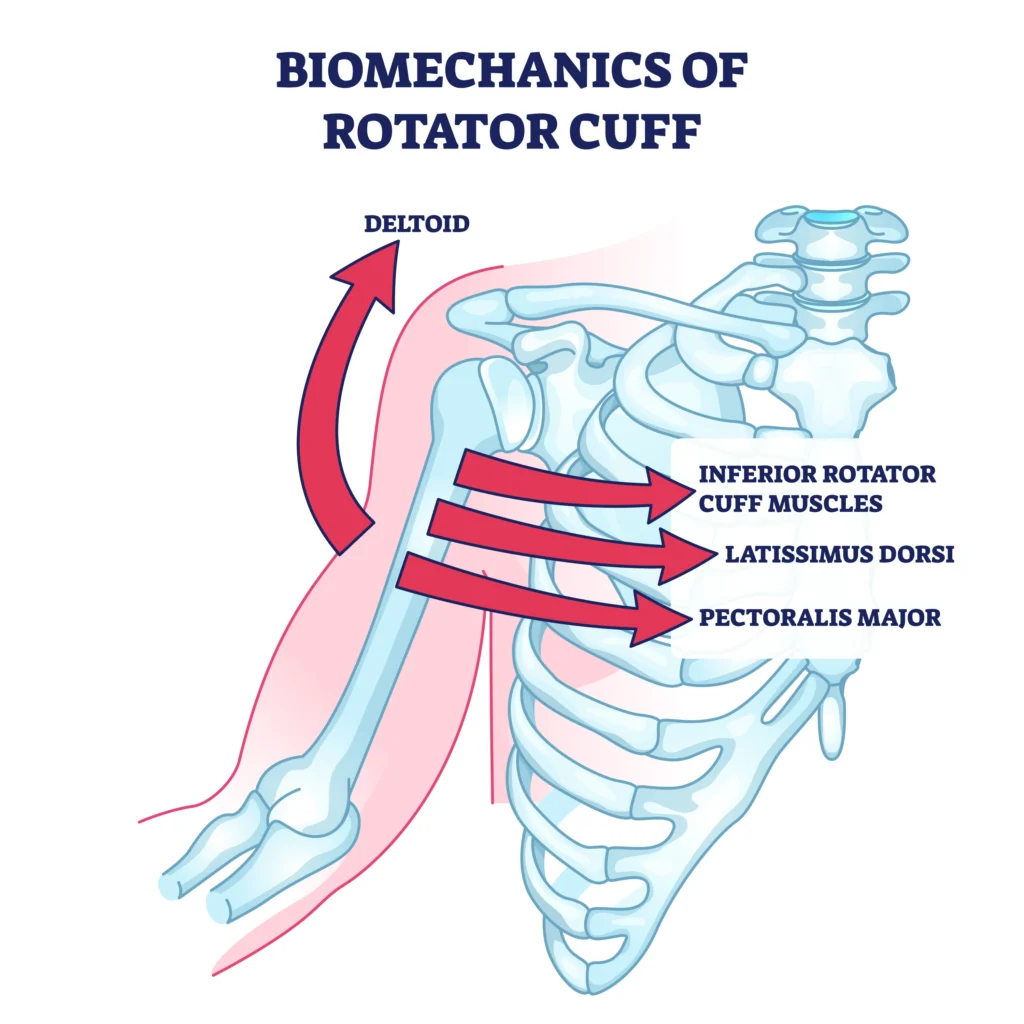
A comprehensive shoulder strengthening program for overhead athletes might typically include:
- External rotation exercises using a resistance band or light dumbbell to target the infraspinatus and teres minor, the main external rotators
- Internal rotation exercises to condition the subscapularis, the largest rotator cuff muscle
- Scaption movements (raising the arm at a roughly 30-degree angle to the side) to engage the supraspinatus in a natural, functional plane
- Scapular strengthening through rows, retractions, and prone Y and T exercises
The scapula, or shoulder blade, deserves particular attention. It serves as the foundation from which the rotator cuff muscles operate. When the scapula does not move correctly during overhead motion, the entire mechanics of the shoulder can be affected. Poor scapular control, sometimes called scapular dyskinesis, is a common contributor to impingement and rotator cuff problems in overhead athletes.
Working with a physical therapist or sports medicine specialist to build a personalized strengthening program is generally more effective than a generic routine. The right program depends on your sport, your current strength levels, and any prior shoulder history.
Mechanics Matter More Than You Might Think
Faulty throwing or overhead mechanics may be one of the more underappreciated contributors to shoulder injury. Poor technique tends to concentrate stress in specific areas of the shoulder, accelerating wear over a season or a career.
For throwers, common mechanical faults include opening up the hips and torso too early, dropping the elbow below shoulder level during the cocking phase, or over-rotating at release. Each of these patterns can shift abnormal forces onto the rotator cuff and labrum. For swimmers, crossing over the centerline during the catch phase or allowing the elbow to drop during the pull adds internal rotation stress to the shoulder. Tennis players sometimes use grip or body rotation patterns that transfer undue load to the shoulder when the hips and trunk fail to contribute efficiently.
Improving mechanics takes time and deliberate effort. Working with a qualified coach or trainer who understands sport-specific biomechanics can be very worthwhile. Video analysis has become a practical and increasingly accessible tool for identifying subtle faults that are difficult to notice in real time. Even small mechanical adjustments, made consistently over time, may reduce cumulative stress on the shoulder and potentially lower the risk of injury over the course of a season.
Managing Your Workload: Rest Is Not Optional
This aspect of prevention may seem straightforward, but it is consistently one of the most overlooked. How much you throw, hit, or swim, and how much you rest, matters enormously.
Overuse injuries occur when the shoulder is loaded beyond what it can adequately recover from. The tendons, labrum, and cartilage in the shoulder need time to adapt between training sessions. When volume increases too quickly, or recovery is consistently shortchanged, cumulative stress begins to accumulate faster than the tissues can repair.
For youth athletes especially, this is a concern. Growth plates in the shoulder are not fully developed until late adolescence, and repetitive stress on these areas before skeletal maturity can create injury patterns that are uniquely problematic for younger players. Pitch count guidelines developed by organizations focused on youth baseball exist for exactly this reason and are generally worth following carefully.
For adult athletes, a few practical habits can help keep workload under control:
- Track your volume. Pitch counts, swing counts, and training yardage are all trackable metrics that can help you make more informed decisions about when to push and when to pull back.
- Increase volume gradually. A commonly suggested guideline is to avoid increasing total weekly training volume too quickly, often by no more than roughly 10 percent from one week to the next.
- Respect the off-season. Many overhead athletes benefit from a planned period each year during which overhead activity is meaningfully reduced. This gives the shoulder a genuine recovery window.
- Prioritize sleep. Recovery happens during rest.
Warm Up With Purpose
Many athletes stretch briefly and then jump straight into full-intensity activity. That approach may not adequately prepare the shoulder for the demands of overhead sport.
A more effective warm-up for overhead athletes tends to be dynamic, involving movement rather than prolonged static holds. The goal is to increase blood flow to the shoulder muscles, activate the rotator cuff and scapular stabilizers, and rehearse overhead patterns at a gradually increasing intensity before reaching full effort.
A purposeful warm-up for an overhead athlete might include arm circles, cross-body swings, and band pull-aparts to loosen the shoulder capsule and activate the rotator cuff. Light scapular retraction exercises and progressive overhead reach patterns can help engage the shoulder blade stabilizers before loading begins. From there, a gradual build-up, starting at lower effort and working toward full intensity over the first several minutes of activity, gives the shoulder a better chance of performing well without accumulating unnecessary early stress.
Cooling down after activity is equally worthwhile. Gentle posterior shoulder stretches and chest-opening movements address two areas that tend to tighten significantly in overhead athletes, and addressing that tightness regularly may help reduce injury risk over the long term.
Recognizing Warning Signs Early
Prevention strategies can reduce risk considerably, but no approach eliminates it entirely. Knowing when something warrants attention is just as important as the preventive habits themselves.
Mild muscle soreness following heavy training is generally expected. Pain that persists across multiple training sessions, worsens during activity, or begins interrupting sleep may be a signal worth taking seriously. Many athletes wait too long before seeking evaluation, hoping the discomfort will resolve on its own. When it does not, delayed attention may result in a longer and more complex recovery down the road.
Some specific warning signs worth noting include pain in the front or back of the shoulder during or after overhead activity, a sense of weakness or difficulty controlling the arm late in a throwing motion, a clicking or catching sensation inside the joint, or discomfort that radiates down the arm. If any of these occur consistently, scheduling an evaluation with a shoulder specialist can help clarify what is happening and what options may be available.
Summary
Learning how to prevent shoulder injuries in overhead sports comes down to giving the shoulder the consistent support it needs before problems develop. A strong rotator cuff, stable scapular mechanics, efficient technique, thoughtful load management, and a thorough warm-up routine all work together to reduce risk and keep overhead athletes competing at their best. None of these strategies require dramatic changes to your routine, but they do require intention and follow-through over time.
Frequently Asked Questions
How early should overhead athletes start shoulder injury prevention training?
Prevention training is beneficial at virtually any age. For younger athletes, building foundational rotator cuff strength, learning sound mechanics early, and respecting pitch count and volume guidelines can be especially impactful, since the shoulder is still developing during adolescence. For adult athletes, there is generally no point at which it is too late to build a more protective routine.
Can I keep playing my sport if I have mild shoulder pain?
That depends on the nature and cause of the pain. Mild, occasional soreness following a heavy training session may be manageable with rest and reduced volume. However, pain that persists across multiple sessions, worsens with overhead activity, or starts showing up at rest warrants a proper evaluation. Continuing to play through meaningful pain can delay the healing process and potentially turn a minor issue into a more significant one.
What makes an overhead athlete’s shoulder injury different from a typical shoulder injury?
Overhead athletes place repeated high-velocity stress on the shoulder in ways that most people, and even athletes in other sports, do not. This can create specific wear patterns and injury types that are more common in this population.