The elbow is a complex joint that facilitates both hinging movements and rotation of the forearm, making it essential for countless daily tasks. When experiencing pain in elbow joint when bending arm, it can signal underlying issues that range from overuse injuries to degenerative conditions. Understanding the potential causes, recognizing the warning signs, and exploring available treatment options can help you take the first steps toward relief.
Key Takeaways
- Pain when bending the elbow can result from various conditions including tennis elbow, golfer’s elbow, bursitis, arthritis, and nerve compression.
- Symptoms may range from mild discomfort to sharp, debilitating pain and can be accompanied by stiffness, swelling, weakness, or tingling sensations.
- Treatment approaches vary from conservative methods like rest, physical therapy, and medications to surgery when necessary.
Understanding the Elbow Joint
The elbow joint connects three bones: the humerus (upper arm bone), the radius, and the ulna (the two bones of the forearm). The structure allows for two primary types of movement. The hinge motion enables you to bend and straighten your arm, while the pivot motion allows you to rotate your forearm, turning your palm up or down.
Supporting this complex system are several key structures that provide stability and enable smooth movement. Tendons connect muscles to bones to produce motion, while ligaments connect bones to each other to stabilize the joint. Cartilage covers the ends of bones, allowing them to glide smoothly, and synovial fluid reduces friction during movement. Bursae are small, fluid-filled sacs that cushion areas where bones, tendons, and muscles meet. Nerves, including the ulnar, radial, and median nerves, travel through or near the elbow and control sensation and muscle function in the forearm and hand.
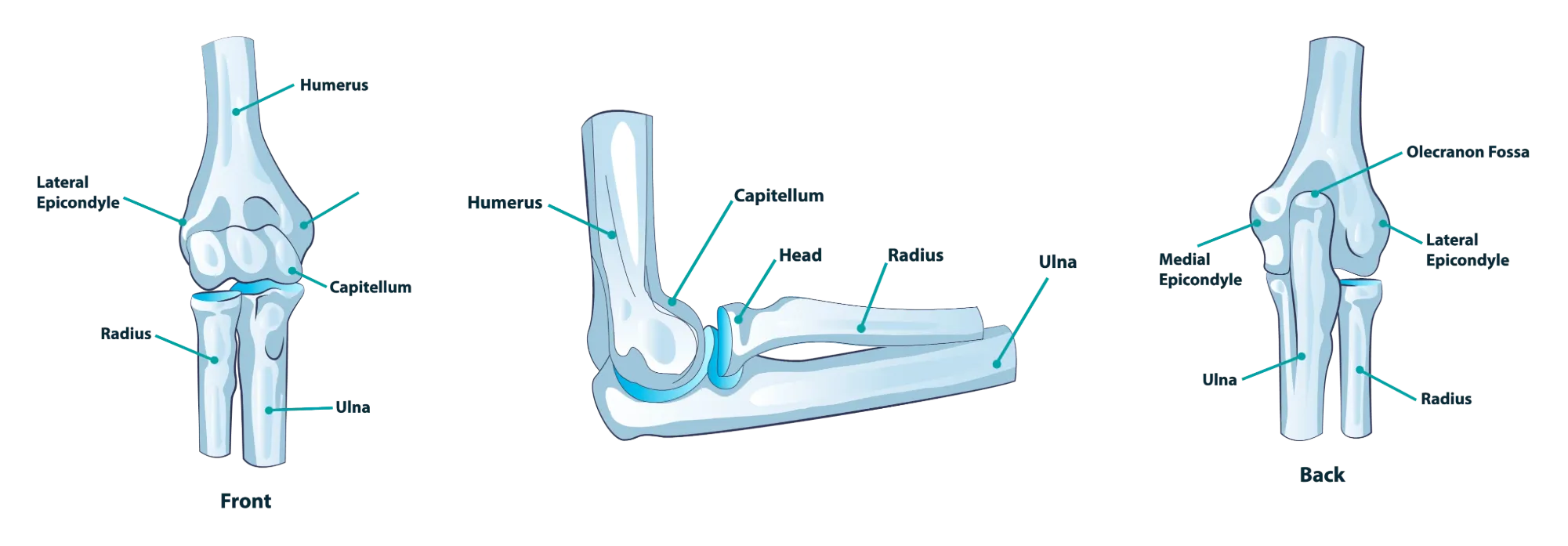
When you bend your arm, these components must work in harmony. Any damage, inflammation, or degeneration affecting these structures can lead to pain and dysfunction.
Common Causes of Elbow Pain When Bending
Pain in the elbow joint when bending the arm can stem from numerous conditions, each with distinct characteristics and underlying mechanisms. In the following subsections, we’ll review some common causes.
Lateral Epicondylitis (Tennis Elbow)
Despite its name, tennis elbow doesn’t exclusively affect tennis players. This condition involves inflammation and degeneration of the tendons that attach to the lateral epicondyle, the bony prominence on the outside of the elbow. The extensor muscles of the forearm, which help extend the wrist and fingers, originate at this point. Repetitive gripping, twisting, or lifting motions can strain these tendons over time.
Symptoms typically include pain and tenderness on the outer side of the elbow that may radiate down the forearm. Activities like gripping objects, shaking hands, or turning a doorknob can worsen the discomfort.
Medial Epicondylitis (Golfer’s Elbow)
Golfer’s elbow affects the tendons that attach to the medial epicondyle, the bony bump on the inside of the elbow. These tendons connect to the flexor muscles that help bend the wrist and fingers. Similar to tennis elbow, this condition results from repetitive stress, often from activities involving gripping, twisting, or flexing the wrist.
Pain and tenderness concentrate on the inner side of the elbow and may extend along the inner forearm. Weakness in the wrist and hand, difficulty making a fist, and pain when bending the elbow or flexing the wrist are common symptoms. Activities like swinging a golf club, throwing, or even typing may aggravate the condition.
Olecranon Bursitis
The olecranon bursa is a small, fluid-filled sac located at the tip of the elbow, between the skin and the underlying bone. This bursa can become inflamed due to prolonged pressure, trauma, infection, or conditions like gout or rheumatoid arthritis. Swelling at the back of the elbow is often the most noticeable symptom, sometimes creating a visible “goose egg” appearance. The area may feel warm and tender to the touch. While bending the elbow might be painful, the swelling itself may cause more discomfort than the motion.
Elbow Arthritis
Arthritis in the elbow can take several forms. Osteoarthritis, the most common type, occurs when the protective cartilage that cushions the ends of bones gradually wears away over time. This degeneration can result from aging, previous injuries, or repetitive stress. Rheumatoid arthritis, an autoimmune condition, can also affect the elbow joint, causing inflammation of the synovial lining.
Pain typically worsens with movement and may be accompanied by stiffness, particularly after periods of rest. A grinding sensation might be felt when bending or straightening the arm. Swelling and a reduced range of motion are common, and activities requiring elbow movement can become increasingly difficult.
Biceps Tendinitis
Biceps tendinitis typically refers to inflammation of the long head of the biceps tendon at the shoulder. However, pain at the elbow can sometimes result from irritation or overuse of the distal biceps tendon, where it inserts near the forearm. This condition, though less common, may develop from repetitive lifting or pulling motions. Symptoms often include pain in the front of the elbow that worsens with bending the arm or rotating the forearm. Weakness during activities requiring arm flexion or supination (turning the palm upward) may also be present.
Ulnar Nerve Compression (Cubital Tunnel Syndrome)
The ulnar nerve runs along the inner side of the elbow in a groove called the cubital tunnel. When this nerve becomes compressed or irritated, it can cause a variety of symptoms. Prolonged bending of the elbow, direct pressure on the inner elbow, or anatomical variations can contribute to cubital tunnel syndrome.
Numbness and tingling in the ring and little fingers are hallmark symptoms. Pain may be felt along the inner elbow and forearm. Weakness in the hand, particularly with grip strength, can develop over time.
Elbow Sprains and Strains
Sprains involve damage to ligaments, while strains affect muscles or tendons. These injuries can occur from sudden trauma, such as a fall, or from overuse. An elbow sprain might result from a fall on an outstretched hand, while a strain could develop from repetitive lifting or pulling.
Symptoms may include pain, swelling, bruising, and difficulty moving the elbow through its full range of motion. The severity can range from mild discomfort to significant pain and instability.
Diagnosing the Source of Your Elbow Pain
An accurate assessment helps identify the specific structures involved and guides the selection of appropriate treatments. Your evaluation typically begins with a detailed discussion of your symptoms. Your doctor may ask about when the pain started, what activities make it better or worse, the nature of the pain, and whether you’ve experienced any previous injuries.
During the physical examination, the doctor will inspect your elbow for swelling or deformity and palpate various areas to identify points of tenderness. Range of motion testing helps determine if and where movement is limited or painful.
Depending on the initial findings, your doctor may order imaging studies. X-rays are often the first imaging study ordered and can reveal fractures, arthritis, or bone spurs. MRI offers excellent visualization of soft tissues, including tendons, ligaments, and nerves. Ultrasound can evaluate soft tissue structures in real-time and may help identify inflammation or tendon abnormalities. If nerve compression is suspected, nerve conduction studies can help assess nerve function and pinpoint the location of nerve damage.
Treatment Options: Pathways to Relief
The treatment approach for pain in elbow joint when bending arm depends on the underlying cause, the severity of symptoms, and how the condition affects your daily life. An experienced elbow specialist can help determine the most appropriate treatment strategy for your specific situation.
Conservative Non-Surgical Treatments
Many elbow conditions respond to non-surgical interventions, particularly when treatment begins early.
Avoiding or modifying activities that aggravate your pain is often the first recommendation. This doesn’t necessarily mean complete immobilization, but rather strategic rest from specific movements that provoke symptoms. You might need to temporarily reduce certain work tasks, sports activities, or repetitive motions.
Applying ice to the affected area can help reduce pain and inflammation, particularly after activity. Heat therapy may help relax tight muscles and improve blood flow, though it’s typically used once acute inflammation has subsided. Over-the-counter nonsteroidal anti-inflammatory drugs (NSAIDs) such as ibuprofen or naproxen can help manage pain and reduce inflammation. Bracing may also be recommended in some cases.
A structured physical therapy program may be recommended. Your therapist might use stretching exercises to improve flexibility, strengthening exercises to build supporting muscle strength, manual therapy techniques to improve joint mobility, and education on proper body mechanics and ergonomics.
Surgical Treatments
If conservative treatments fail to provide adequate relief, or in cases of severe structural damage, surgery may be recommended. The specific procedure depends on the underlying condition. Many procedures may be done using minimally invasive arthroscopic techniques.
Summary
Pain in elbow joint when bending arm is a problem that can arise from various conditions, including tennis elbow, golfer’s elbow, bursitis, arthritis, nerve compression, and traumatic injuries. Accurate diagnosis through clinical examination and imaging studies can help guide treatment decisions tailored to your needs. While many cases respond well to conservative approaches, some situations may require surgical intervention.
Frequently Asked Questions
How is elbow pain diagnosed?
Diagnosis typically begins with a detailed medical history and physical examination by an orthopedic specialist. Your doctor will assess your symptoms, examine your elbow for tenderness and range of motion, and may order imaging studies such as X-rays or MRI to visualize the bones and soft tissues. In cases of suspected nerve compression, nerve conduction studies may be performed.
Can I treat elbow pain at home?
For mild to moderate pain, home treatment with rest, ice application, over-the-counter anti-inflammatory medications, and gentle stretching may provide relief. However, if your pain persists beyond a few weeks, worsens with activity, or limits your function, consider consulting an elbow specialist for diagnosis and treatment.
When is surgery necessary for elbow pain?
Surgery may be considered when conservative treatments have failed to provide adequate relief after several months, or in cases of severe structural damage such as complete tendon tears, significant nerve compression that doesn’t respond to conservative care, or advanced arthritis. Your orthopedic surgeon can discuss whether surgical intervention is appropriate for your specific condition.